
Merle Allele Length Classification: Reading and Interpreting Your Dog's Test Results
When a laboratory tests a dog for merle status and returns a result with a number — 200 bp, 247 bp, 315 bp — many breeders are unsure what to do with that information. Binary results (merle positive or merle negative) are simpler to process but dangerously inadequate for breeding decisions. Understanding allele lengths is not optional for anyone producing or planning to produce merle puppies.
This guide explains what merle allele length testing measures, what the different ranges mean, how to read your laboratory report, and how allele length should inform your breeding decisions. It is the practical companion to the molecular science covered in our guide to the SILV/PMEL17 gene.
What Allele Length Testing Measures
The merle pattern in dogs is caused by a SINE retrotransposon insertion in intron 10 of the PMEL17 gene. This SINE insertion contains a poly-adenine tail — a repeating sequence of adenine nucleotides at its end. The length of this poly-A tail varies between individual dogs and is the primary determinant of how strong the merle effect is on the coat.
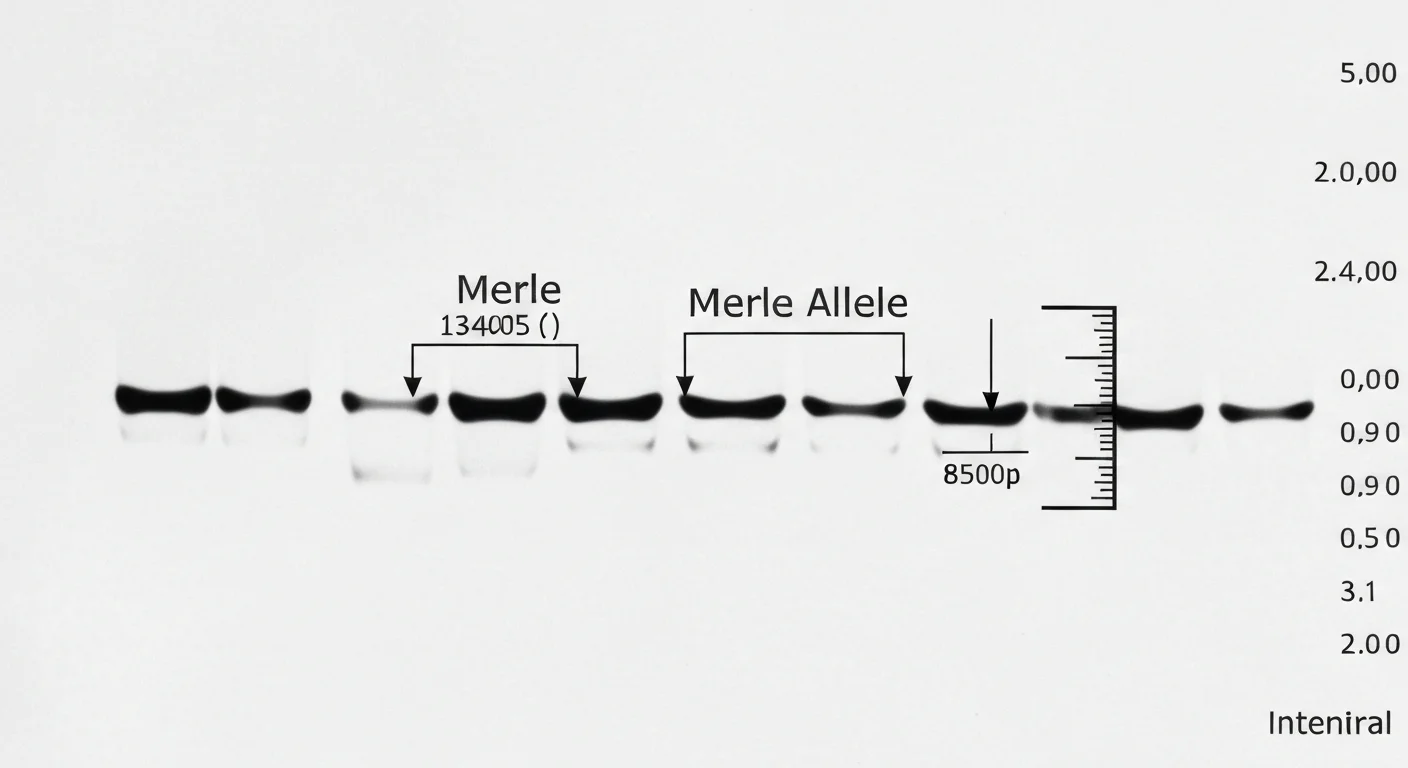
Allele length testing uses PCR-based fragment analysis to measure the total length of the SINE insertion, including its poly-A tail, in base pairs (bp). The result represents the size of the merle allele relative to a non-merle (wildtype) allele. A dog who is non-merle carries two copies of the wildtype allele and will show no SINE insertion in the merle region.
The result from the laboratory describes each allele the dog carries. A heterozygous merle dog carries one wildtype allele and one merle allele of some length. A homozygous merle dog carries two merle alleles, which will have their own individual lengths. The instability of the merle allele — its tendency to change length across generations — is the reason individual testing is necessary, a phenomenon documented in our guide to merle allele instability.
The Classification Ranges
Different laboratories use slightly different nomenclature, but the underlying classification system is broadly consistent. The following ranges reflect the commonly used framework:
| Allele Length Range | Classification | Coat Effect | Breeding Status |
|---|---|---|---|
| Below 200 bp | Non-merle (m) | None | Safe to breed to any merle |
| 200 – 230 bp | Cryptic merle (Mc) | Minimal to none (may have tiny flecks) | Treat as merle carrier — only breed to confirmed m/m |
| 231 – 246 bp | Atypical merle (Ma) | Partial dilution, irregular pattern | Treat as merle carrier — only breed to confirmed m/m |
| 247 – 254 bp | Classic merle (M) | Standard merle pattern | Only breed to confirmed m/m |
| 255 – 264 bp | Harlequin (Mh) | Strong pattern with white base areas | Only breed to confirmed m/m — additional complexity in Great Danes |
The crucial point is that every allele in the 200 bp and above range must be treated as a merle carrier status for breeding purposes, regardless of how little visible coat effect it produces. This is why binary positive/negative testing is insufficient — a dog who tests "merle negative" on a basic panel may still carry a cryptic allele above the 200 bp threshold on a comprehensive length test.
A cryptic merle dog (200–230 bp) can produce full classic merle offspring or even double merle offspring when bred to another merle carrier. The shortened allele can expand to a longer length in the next generation. A dog classified as cryptic merle must be treated with identical breeding caution to a classic merle. The hidden danger of these carriers is documented in detail in our cryptic merle guide.
Reading a Laboratory Report
A standard allele-length test result will typically present the dog's result in one of two formats. The first format gives two numbers separated by a slash (e.g., m/M — non-merle allele/merle allele), where the letters correspond to the classification categories above. The second format gives the actual base pair measurements for each allele (e.g., 189/247 bp), which you must then map to the classification table.
Some reports provide both. When only the classification letters are given, contact the laboratory to confirm the underlying base pair measurements — this level of detail is important for understanding the specific risk profile and for monitoring allele stability across generations as part of your breeding record keeping programme.
When a Dog Carries Two Merle Alleles
A double merle dog — one who inherited a merle allele from both parents — will show two alleles in the merle range. The laboratory report might read, for example, M/M (two classic merles), or Mc/M (cryptic and classic), or M/Mh (classic and harlequin). In any case, this dog cannot safely be bred to any dog carrying any merle allele. Only a confirmed m/m partner (with both alleles below 200 bp) is a safe pairing.
For placement decisions, the allele combination in a double merle dog informs the expected health risk — two longer alleles carry greater expected sensory development disruption than two shorter alleles. However, all double merle pairings produce double merle offspring at a 25% rate regardless of allele length, and this breeding risk applies equally regardless of the individual dog's health outcomes.

Variation Between Laboratories
Laboratory-specific cut-off values for the classification categories can vary slightly between providers. The ranges given above are representative but should be confirmed against the specific laboratory's published classification criteria. When comparing results from different laboratories across generations, note the laboratory name and specific methodology to ensure meaningful comparison.
The three most widely used laboratories for merle allele-length testing in Europe and North America — Antagene, Laboklin, and UC Davis Veterinary Genetics Laboratory — all offer comprehensive allele-length testing, though their specific reporting formats differ. Testing options are reviewed in our complete guide to testing before breeding.
Practical Application: Using Your Results
Once you have allele-length results for your breeding stock, the decision rules are straightforward:
- If your bitch is in any merle range (200 bp or above on either allele), she may only be bred to a confirmed m/m male
- If your male is in any merle range, he may only be used at stud with confirmed m/m bitches
- Document all allele lengths in your breeding records and provide them to buyers with every puppy
- Require testing of any external dog before any mating proceeds, regardless of visual appearance
Understanding allele lengths transforms merle breeding from a game of visual guesswork into a manageable, predictable system. Every breeder who understands this classification framework and applies it consistently removes one more source of preventable double merle production from the population. The goal described in responsible merle breeding — no more MM puppies — is achievable precisely because the science is clear.
Dr. Patricia Wells
Canine Coat Genetics Specialist
Veterinary geneticist with over 25 years researching coat colour inheritance in domestic canids. Former research fellow at the Animal Health Trust and consultant to multiple breed health programmes across Europe and North America.
View all articles