
Are Merle Dachshunds Ethical? Dapple Genetics, Health and Breeding Rules
A merle Dachshund, known in the breed as a dapple, can be bred ethically. Dapple is a traditional Dachshund pattern, described in the American breed standard and accepted for registration by the Royal Kennel Club, and a single dapple from a dapple to non-dapple mating is not the dog behind the health warnings. Dapple to dapple breeding is a different matter: it is expected to make about one puppy in four a double dapple, with a much higher risk of deafness and eye defects.
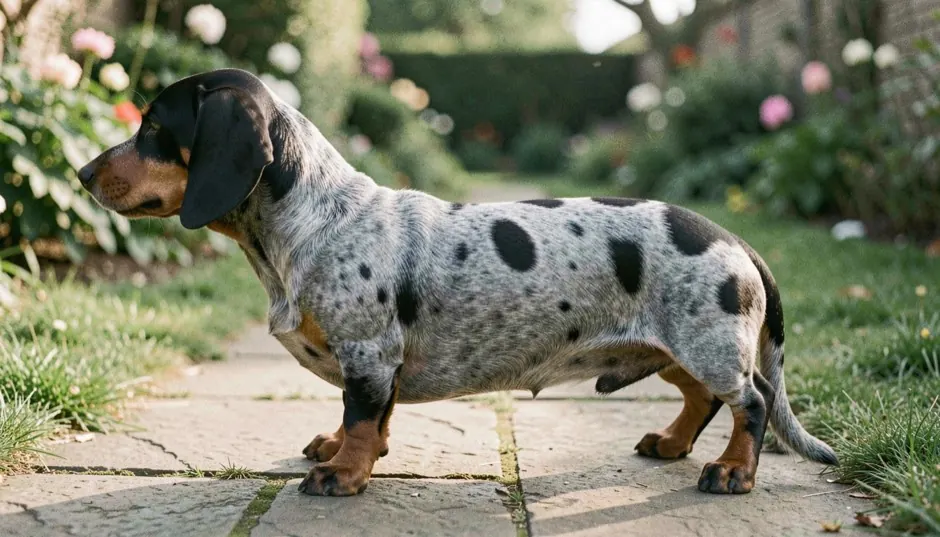
The ethical line therefore does not run between dapple and solid Dachshunds. It runs between breeders who test both parents at the merle locus before every mating and breeders who rely on how a dog looks.
What is a dapple Dachshund?
Dapple is the Dachshund name for merle. A study published in PNAS in 2006 traced the merle pattern to an insertion in the PMEL gene, then called SILV, and found that merle dogs from six breeds, the Dachshund among them, all carried one copy of it. The insertion lightens eumelanin, the black or brown pigment, in irregular areas, so darker patches stand out on a paler ground.
The breed standard published by the Dachshund Club of America, the AKC parent club, approved in November 2017, describes dapple as lighter-coloured areas contrasting with a darker base colour, with neither the light nor the dark colour predominating. It accepts partially or wholly blue eyes in dapples as readily as dark eyes. The Royal Kennel Club standard says much the same in its own words and allows one or both wall eyes in a dapple.
Is dapple a traditional Dachshund colour?
Yes, and this is what separates the Dachshund from breeds where merle is a recent arrival. When the Royal Kennel Club announced in January 2020 that it would stop registering merle dogs in breeds without a documented history of the colour, it named eleven breeds in which merle registrations would continue. The Dachshund, with the colour known as dapple, is one of them. Pomeranians and French Bulldogs are not on that list.
That history does not make every dapple litter acceptable. It does mean that in Dachshunds the ethical question is how dapple is bred, not whether the pattern belongs in the breed.
Are single dapple Dachshunds healthy?
Most are, but the risk is not zero. A study published in the Journal of Veterinary Internal Medicine in 2009 tested the hearing of 153 merle dogs of several breeds with the BAER test and genotyped each of them. Dogs with one copy of merle were far less often deaf than dogs with two.
| Genotype | Deaf in one ear | Deaf in both ears |
|---|---|---|
| Single merle (Mm) | 2.7% | 0.9% |
| Double merle (MM) | 10% | 15% |
The sample was not limited to Dachshunds, so these figures describe merle dogs in general, but they put the difference between one copy and two in plain numbers. For a breeder, the practical consequence is that a single dapple kept for breeding deserves a BAER hearing test and an eye examination, and a buyer deserves to see both reports.
Why is dapple to dapple breeding unethical?
Each dapple parent carries one copy of the merle insertion. A dapple to dapple mating is therefore expected to produce, on average, one double dapple in every four puppies, two single dapples and one non-dapple. Nobody can choose which puppy inherits two copies.
The Royal Kennel Club standard describes a double dapple as a dog with varying amounts of white all over the body in addition to the dapple pattern, and lists it among unacceptable colours. The club does not register puppies from merle to merle matings at all, because dogs with two copies have an increased risk of eye and ear problems causing blindness or deafness. The clinical picture, from small or malformed eyes to complete deafness, is the same in Dachshunds as in other breeds and is set out in our medical guide to double merle health problems.
A litter that may contain a blind or deaf puppy in exchange for more dapple puppies to sell is a trade I do not consider defensible. No colour preference changes that arithmetic.
How can a red Dachshund hide dapple?
Merle acts on eumelanin and leaves phaeomelanin, the red and yellow pigment, untouched. On a clear red or cream Dachshund there is little black or brown pigment for the dapple to lighten, so a dog carrying dapple may show only a few faint patches or a blue eye, and sometimes nothing visible at all.
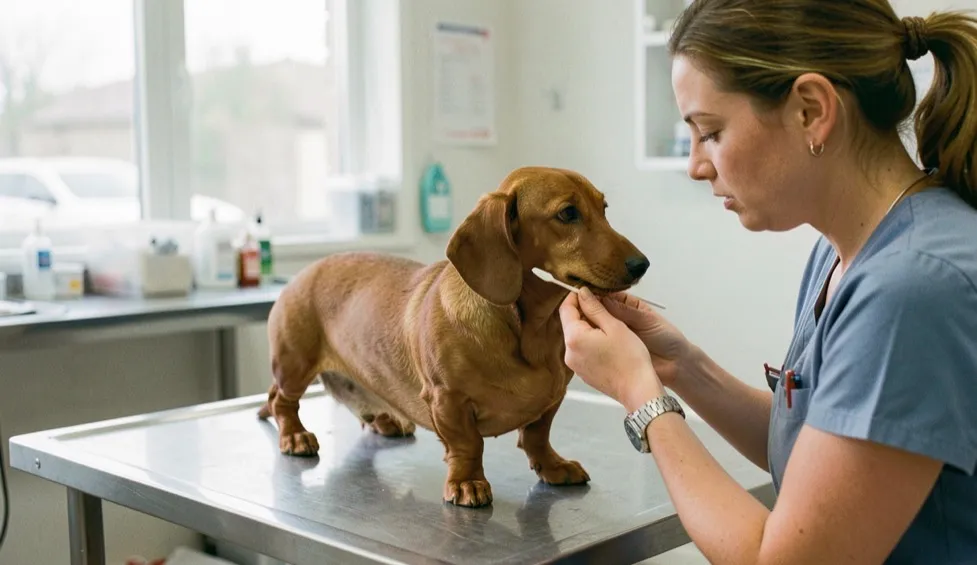
A 2021 study of the PMEL gene in 140 Dachshunds, published in Human Genetics, identified numerous cases of truly hidden merle in dogs with light or red coats. It also described a dog that carried a large merle insertion without showing any merle pattern and unintentionally produced a double merle puppy born without eyes. The authors concluded that cryptic, hidden and mosaic variants, which cannot be seen by looking at the dog, make genetic testing before breeding necessary.
Hidden dapple in reds follows the same logic as phantom merle in sable and recessive red coats. It is one way a breeder who believes she is pairing a dapple with a solid ends up with a dapple to dapple litter.
Piebald, which comes from a different gene, adds a second source of white. The American standard describes piebald separately and notes that it lacks the lighter shading of dapple, while the Royal Kennel Club lists piebald among its unacceptable colours. In a puppy that carries both, extensive white can make a single dapple look like a double dapple, or disguise a real double dapple. The DNA result settles what the coat cannot.
What does an ethical dapple breeding look like?
These are the conditions I would expect any dapple litter to meet:
- Both parents tested at the merle (M) locus before the mating, with the allele length reported rather than a simple positive or negative. Our guide to reading merle allele length results explains the classes laboratories use.
- A dapple paired only with a partner whose test shows no merle insertion, never with another dapple and never with an untested red, cream or piebald.
- Hearing and eye examinations for dapple breeding stock, with the reports kept on file.
- The parents' genotypes and the expected outcome of the pairing given to every buyer in writing.
| Pairing | Expected litter | Double dapple risk |
|---|---|---|
| Dapple x tested non-dapple | About half dapple, half non-dapple | None expected |
| Dapple x dapple | About 1 in 4 double dapple, 1 in 2 dapple, 1 in 4 non-dapple | About 25% |
| Dapple x untested red or cream | Cannot be predicted | Present if the partner hides dapple |
Merle alleles can occasionally change length between parent and offspring, which is why any puppy kept for breeding is tested in its own right rather than assumed to match a parent.
What should a buyer ask before choosing a dapple puppy?
Ask whether one parent or both are dapple, and ask to see both parents' merle test results with allele lengths. A breeder who cannot show a result for the non-dapple parent has not ruled out a dapple to dapple mating. Ask whether the puppy has had a hearing test and an eye examination.
Look at the white in the coat. White spread over the body is how the Royal Kennel Club standard describes a double dapple, whereas a large white area on the chest alone is permitted in a dapple by the American standard. Blue eyes on their own are not a warning sign in a dapple, since both standards accept them. Unusually small eyes, oddly shaped pupils or a puppy that does not react to sound are reasons to see a veterinarian before committing.
Dapple Dachshund at a glance
- Gene: PMEL (formerly SILV), the merle (M) locus
- Inheritance: one copy gives a dapple, two copies give a double dapple
- Standards: dapple described in the Dachshund Club of America standard and permitted by the Royal Kennel Club; double dapple listed as unacceptable by the Royal Kennel Club
- Test: DNA test at the M locus, with allele length, on both parents before every mating
Frequently asked questions
Is a dapple Dachshund the same as a merle Dachshund?
Yes. Dapple is the name Dachshund breeders use for merle, and the 2006 PNAS study found the same PMEL insertion in dapple Dachshunds as in merle dogs of other breeds.
Can you breed two dapple Dachshunds together?
It is physically possible, but it should not be done. About one puppy in four is expected to be a double dapple, and the Royal Kennel Club does not register puppies from merle to merle matings.
Do blue eyes mean a dapple Dachshund is unhealthy?
No. The Dachshund Club of America and Royal Kennel Club standards both accept partly or wholly blue eyes in dapples. Eye size and shape matter more than colour, and any doubt calls for an examination by a veterinary ophthalmologist.
Dr. Patricia Wells
Canine Coat Genetics Specialist
Veterinary geneticist with over 25 years researching coat colour inheritance in domestic canids. Former research fellow at the Animal Health Trust and consultant to multiple breed health programmes across Europe and North America.
View all articles